Archival Research Strategies for Historical Documentaries in Berlin
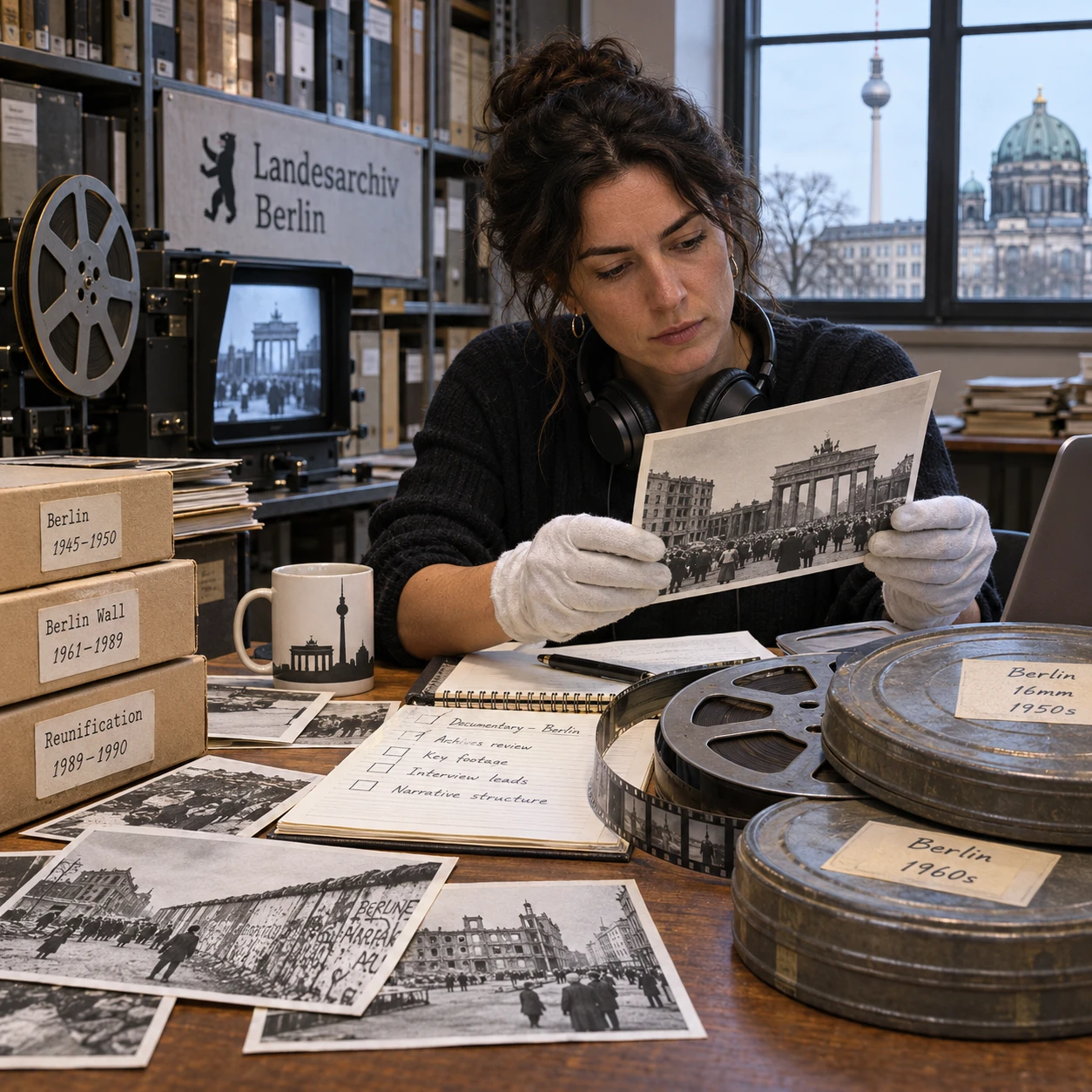
Berlin’s history is recorded across public archives, federal collections, museums, broadcasters, film repositories, and private holdings. For documentary filmmakers, the challenge is not simply finding material; it is establishing what a source shows, where it came from, and whether it can be used in the finished film.
A reliable process connects the film’s question to targeted searches, source verification, rights clearance, and a well-maintained research log. That process keeps compelling images from outrunning the evidence behind them.
Start with a focused research question
A focused research question defines the period, places, people, and kinds of evidence to search for. Set those boundaries before entering catalogue terms so research remains tied to the film’s story.
Turn a broad idea, such as a documentary about everyday life in divided Berlin, into questions you can investigate: Which district and years? Whose daily life? What change or event does the film examine? Then list the evidence that could answer each question, such as a street photograph, a municipal record, a newsreel, or a recorded interview.
Use a compact planning grid:
- Scope: Define dates, geography, and the people or institutions involved.
- Claim: Write the historical point the film may make, as a question rather than an assumption.
- Evidence: Identify source types that could support, complicate, or disprove it.
- Gaps: Note whose experience may be missing from official records or surviving footage.
This approach prevents a common trap: collecting striking material simply because it is available. A dramatic image may be visually useful but irrelevant to the claim, while an ordinary document may reveal the detail the story needs. Keep the question flexible; archival research often changes a film’s scope once the evidence points somewhere unexpected.
Map Berlin’s archival landscape
Berlin’s archival material is spread across organizations, so no single catalogue provides a complete view. Identify likely custodians by source type, the institution that created or collected the material, and the period your film covers.
The Landesarchiv Berlin (Berlin State Archive) is a key starting point for records relating to the city and its administration. The German Federal Archives (Bundesarchiv) holds federal records and audiovisual material within its collections. Their holdings and search systems differ, so treat them as complementary rather than interchangeable.
Also investigate specialist film archives, broadcasters, museums, district and institutional archives, and collections connected to particular communities or organizations. For first-person accounts, look for oral history collections at universities, museums, foundations, and other research institutions. An interview may be catalogued by a project or donor rather than by the event you are researching.
Use each institution’s official catalogue or research guidance to confirm what it holds, how access works, and whom to contact. Collection descriptions can point to related repositories, but they do not guarantee that an item is digitized, available for immediate consultation, or cleared for film use. A useful first-contact message names your subject, date range, intended production, and the specific material you hope to find.
Search catalogues and finding aids effectively
To search Berlin catalogues effectively, combine names, places, dates, and subject terms, then vary each term. Finding aids and catalogues often describe materials using the language of the original creator, which may differ from a filmmaker’s wording.
Start with a small search matrix rather than one broad keyword. For a location, try the street or square name, district, former names, and nearby landmarks. For a person or organization, search full names, initials, alternate spellings, and relevant departments. Berlin’s political and administrative boundaries changed over time, so a record may use a historical district name or a former institutional title.
- Search a date range and then narrower periods; catalogue dates may describe a file, not every item inside it.
- Try German and English terms where relevant, along with period-specific or administrative terminology.
- Use subject headings and collection descriptions to find adjacent records, not just exact keyword matches.
- Record unsuccessful searches and terms tried, then ask an archivist whether another collection or naming convention may apply.
When a catalogue result looks promising, capture its full reference, title, creator, date range, and access notes. A few minutes spent recording the path to an item can save a return visit and help a researcher or archive staff member locate it later.
Evaluate and verify archival material
Verify archival material by checking its provenance, metadata, date, and historical context against independent evidence. A caption or catalogue entry is a useful lead, but it should not be treated as proof of every detail in the image.
Start with provenance: who created the item, who preserved or donated it, and whether it has a documented chain of custody? Then inspect available metadata, including creator, original purpose, format, recording or publication date, and any later annotations. Distinguish the date an image was made from the date it was filed, copied, or digitized.
For a photograph, check whether signage, building details, uniforms, vehicles, weather, or known events support the proposed date and location. For film, confirm whether the sequence is contemporary footage, a later compilation, or material reused in a newsreel. Editing, narration, and soundtrack can change how viewers interpret an image. Cross-check important claims against other records, contemporary newspapers, maps, and oral history accounts.
Keep uncertainty visible in the source log. Use labels such as “catalogue date,” “probable location,” or “unverified attribution” until evidence supports a firmer statement. This protects the documentary from turning a plausible inference into an asserted fact and gives the editor a clear basis for captions and voice-over.
Plan access, permissions, and digitization
Plan access, permissions, and digitization as separate tasks: permission to inspect an item does not automatically grant the right to reproduce or distribute it. Contact the relevant archive and rights holder early, especially when the film has a fixed delivery date.
First confirm the access process. Some collections require advance appointments or staff-assisted retrieval; others offer online descriptions or digital copies. Procedures, fees, and turnaround times vary by institution and item, so verify current terms directly rather than relying on another project’s experience.
For each selected item, ask who owns the physical object, who controls copyright, and whether additional permissions apply. A photograph, film clip, soundtrack, or embedded artwork may involve different rights holders. Clarify intended use, territories, platforms, audience, term, edits, and promotional use. Access is not usage clearance, and paying a reproduction fee does not necessarily clear copyright.
Discuss digitization specifications before ordering files. Ask about available resolution, frame rate or scan format, color, audio, watermarking, delivery method, and whether the archive can supply a citation or credit line. High-quality files may cost more or take longer to prepare; a lower-resolution research copy can help with early editing, but confirm that a suitable master can be licensed for final release. Track requests, quoted terms, approvals, and restrictions in one rights log.
Shape research into a documentary narrative
Turn archival research into a documentary narrative by linking each source to a specific question or story beat. A source log, timeline, and rights log help the production team distinguish verified evidence from leads and licensed material from material still under review.
For every item, record the repository, collection and reference number, creator, title, date, location, description, provenance notes, access details, rights status, and file name. Add a short note explaining what the item can support and what it cannot establish. This last field matters: a photograph may show a street at a particular moment, but not what everyone there thought or experienced.
Arrange findings chronologically or by theme, then compare them with interviews, documents, maps, and present-day footage. Oral histories can add lived experience, while administrative records may reveal how an institution described the same event. Where accounts conflict, preserve the disagreement in your research notes and decide whether the film should present competing interpretations.
Choose archival material for both evidence and form. A sequence of official images can establish how authorities represented a place; an interview, personal photograph, or quiet detail may reveal what that framing left out. The strongest edit makes the relationship clear to the audience, including gaps and uncertainty, rather than using archival footage as decoration.
Frequently asked questions
Which Berlin archives should documentary filmmakers consider?
Start with the Landesarchiv Berlin for city-related records and the Bundesarchiv for federal and audiovisual holdings. Depending on the subject, also search specialist film archives, broadcasters, museums, district or institutional collections, and oral history projects. The right repository depends on who created or preserved the material.
How can I find archival film footage related to Berlin?
Search the catalogues of the Bundesarchiv and relevant film archives, then widen the search to broadcasters and institutional collections. Try location names, historical terms, dates, organizations, and event names. Ask about uncatalogued or differently described material, and confirm whether a result is original footage or a later compilation.
How do I verify the date and context of an archival photograph?
Check the creator, collection history, caption, and metadata, then compare visual clues with dated maps, records, newspapers, or other images. Treat catalogue dates as claims to assess, especially when they describe a whole file rather than an individual photograph.
What permissions are needed to use archival material in a film?
You may need permission to reproduce the item, a copyright license, and separate clearance for any third-party content within it. Requirements depend on the rights holder and intended use. Get written terms for the film’s platforms, territories, duration, edits, and promotion before locking the material into the final cut.